How to Film a Tropical Villa So It Looks Like Itself
Every villa on that coast shares the same jungle, the same ocean and the same light. Finding what belongs to one house in particular.
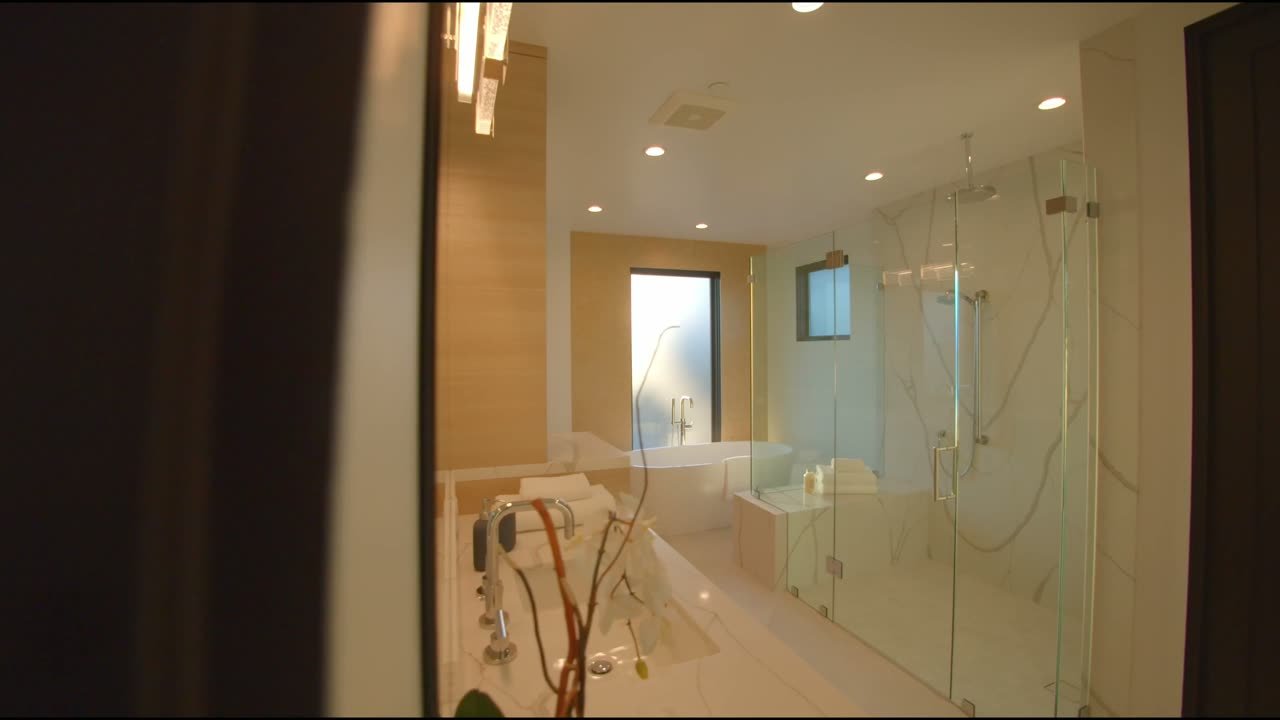
Tropical property footage has a shared vocabulary: the pool merging into the horizon, the palm fronds, the drone rising over the canopy. It's shared because it works. Those things are genuinely beautiful and buyers respond to them.
The trouble is that a house filmed only with that vocabulary could be almost any house on the coast. The buyer remembers the setting and forgets the property.
What follows is how I go looking for the part that belongs to one house and no other.
Spend the first half hour not filming
Walk the place with nothing in your hands.
What's unusual here? A stair cut into rock. A tree the builders worked around instead of felling. A window placed for one specific view. An outdoor kitchen someone clearly designed for themselves rather than for a rental listing.
You're looking for evidence of a decision. Anything that came from a person rather than a catalogue is the thing worth building the film around.
Ask who made it and why
If the owner or the agent is there, two questions do most of the work: what made you choose this plot, and what would you not change.
The answers rarely go in the film. They tell you what to point the camera at, which is more useful.
Film the particular before the general
The wide shot will happen anyway. You need it, and it takes two minutes.
The specific material is what disappears if you don't go after it early: the way afternoon light lands on one wall, the sound of the trees behind the terrace, the depth you get shooting through a doorway from the far side of the house.
I work with a lot of foreground. There's usually something to place close to the lens, a plant, a beam, the edge of a doorway, and shooting past it at a moderate telephoto gives real depth and a bit of parallax as the camera moves. It's the simplest way to make a room feel like somewhere rather than a floor plan.
Use what the architecture already does
Houses on that coast tend to be built open: sliding walls, roofed terraces, rooms that run into the garden. Big openings mean a lot of light, and light is what shows volume.
So rather than lighting anything, I open the far side of the house and let it come through. The exposure is set for the bright side and the shade is lifted by whatever the building gives back: pale stone, water, a light floor.
That approach is free, and it looks like the house rather than like a set.
The drone's job is location, not decoration
One frame that holds the house, the trees and the water answers the question a distant buyer asks first: where is this, exactly.
After that, aerials stop adding information. An arrival, perhaps a departure, and the camera comes back to eye level where somebody can picture themselves.
There's also a practical constraint I take seriously: staying inside the property's boundary. Plots are rarely rectangular and houses sit close together under tree cover, so a clean pass often needs a movement designed for that one plot: an arc that stops short, a rise that leans away. Nobody watching notices, which is the point.
Keep the edit honest
Two habits I hold to.
Bedrooms sit in the middle. They're seldom the strongest rooms and they blur together after the second one, so I put them where attention naturally dips and keep the opening and the close for what holds someone.
And the length stays between forty-five seconds and a minute ten. Long enough to show the house, short enough that people reach the end.
What I'll know later
I'm writing this in France, before moving to Santa Teresa in September. The method is what I use on properties here, and it's built to find the particular rather than the picturesque, which is exactly what travels.
What I don't have yet is the local eye: which details a buyer in that market looks for, what the wet season does to a garden, how those houses feel at seven in the morning. I'll write that version once I've filmed a few.
The property work behind this method is on this page.